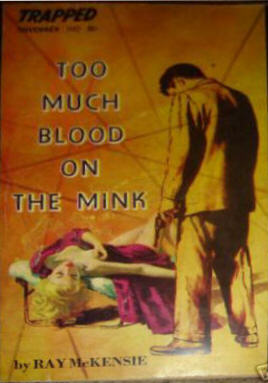
The cover alone is worth the price of admission. It’s such a cool cover that, like Midwood’s Sin of Wheels art by Paul Rader or Gil Brewer’s The Bitch, it’s been reprinted on matchbooks, keychains, coffee mugs, and posters.

The cover also reminds me so much of this former dancer at L.A.’s Jumbo’s Clown Room. When I showed her this cover (she no longer dances, but is an esatte chef in Bel Air) her eyes popped and she said, “That’s me!” Really — same body type, same hair, same lips. Strange.
There’s no date on this, but as a Cornith Leisure Book, it would date between 1965-66. It is on Lynn Munroe’s list of “are they or are they not” Lawrence Blocks from his article,”The First Andrew Shaw.” There’s also question as to whether or not Block continued to write for Hamling and Kemp after 1963, when he and his agent split from Scott Meredith — after all, Meredith contracted all titles to Hamling & Kemp via The Black Box.
I think I’ve become adept at spotting Block’s style. For one, in general, both his and Westlake’s Nightstands and Midwoods are between 9 and eleven chapters, often ten. It’s a pragmatic thing — to get a 50,000 words manuscript, you do ten 5,000 word chapters, or nine 6,000 word chapters, and at on chapter a day, in less than two weeks you have a finished book. (Robert Silverberg’s were all fourteen chapters, until after 1965 when Greenlead required all books to be an exact 12 chapters).
Block also has a way of writing about Greenwich Village, a section of Manhattan that he obviously loves. This is how Sin Alley opens, with colorful depictions of the the streets, trees, and builings of the Village, as well as its doomed youth in th streets:
It is a tough neighborhood.
They fourteen they have smoked their first marijuana cigaratte; by age fifteen they have taken their first hit of H; by sixteen they have graduated to sin-popping and by sixteen they are ready to shoot with medical hardware.
They have already had their first love by age twelve. In the basement or boiler room or hallway or on a fat rooftop, with a girl who is a known tramp, someone from the crowded apartment next door or the street. They start early and soon learn all about that. They know how to get their kicks. (pp. 6-7)
That passage is pure early vintage Block, as if taken from the pages of Pads Are for Passion. In fact, there are a lot of “pads,” man, in early Block, and, like, beatnik lingio, Daddy-O.
In Sin Alley, The Pad is a special place, a cool space, it is “five rooms on the top floor of a four-story brick painted apartment building” (p. 8). No one lives there and some think it is a myth; only those with a key, or know someone with a key, can get in. No one knows who pays for it. But The Pad is a safe place to take a chick and make her, smoke M or shoot H, play jazz and trip and float and ride the reefer wave.
So happens with a girl named Marion in chapter one; she meets a sexy beatnik trumpet player, they have dinner, he gives her booze and speed, and they go up to the pad. He tells her to never talk about The Pad and to deny being there if ever asked. She’s too high to remeber anyway.
Chapters two and thre are in completely different writing styles which causes me to think this is a collaborative novel. Chapter two reads like Westlake’s dense early style and I believe chapter three could be William Coons, who was already ghosting Andrew Shaws as of 1962.
This is a multi-character book, almost a collection of stories, a biout various people in the Village finding their way to The Pad and experiencing mind0-blowing sex and drugs and music. We don’t get back to Marion’s story until chapter six, and back to Block’s writing — in fact, his chaptrs are choppy, stucatto, single word paragraphs that flow like jazz riffs, returning to themes — the way we return to Marion half way through the book.
It’s an okay book, I’m not a fan of multi-character novels or collections disguised as a novel, because you don’t get to know the characters or even care for them. Plus, the different writing styles throughout make it an nerratic read. But like I said at the top, the cover is worth the price of admission into this pad, Daddy-O.
The Spread by Barry Malzberg (Belmont Tower, 1971)
Posted in Barry N. Malzberg, Orrie Hitt, Robert Silverberg, Vintage Sleaze Paperbacks, pulp fiction with tags 1970s, Belmomt Tower, black humor, censorship, dark humor, freedom of press, freedom of speech, insane narrator, satire, smut, smut publishing, smut tabloids, social commentary on November 8, 2009 by vintagesleazepaperbacksOne of Malzberg’s least known books, it has had three editions: this 1971 Belmont Tower edition, a 1977 edition with an art cover, and a 1980 “price breaker” plain cover edtion from Leisure Books.
A note on publisher history: Belmont was once an independent paperback house that specialized in faux sexology studies and popular culture, as well as second rate science-fiction and mysteries. They merged what was left of Midwood (Tower Publications) and became Belmont Tower, then later merged with Lancer Books and formed an inprint, leisure Books — not the same Leisure imprint from Greenleaf/Cornith. Lesiure still exists today as Dorchester Publishing (which published a number of curious books by Linda DuBrieul), which supposedly still has the rights to all these old books, Lesire mainly publishers a popular horror line, romances, thrillers and westerns now.
The Spread is pure black comedy, and a nasty criticism of the sleaze rag era of the 60s-70s, the other half of the biz that went along with the books: nudie mags and newspapers under the guise of adults news and entertainment…
Read more »
1 Comment »